Two Centuries, One Bowl: The Quiet Migration of a Brass Object Into an American Bedroom
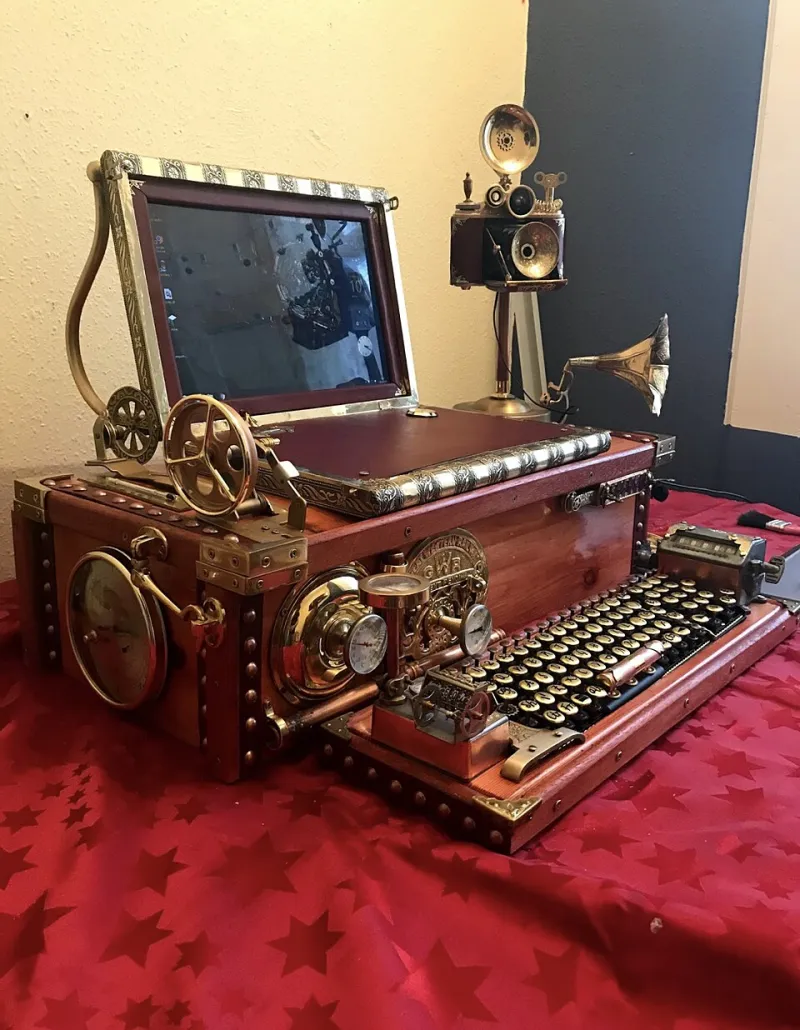
Photo: Abraham parseghian, CC BY-SA 4.0, via Wikimedia Commons
On a dresser in Columbus, Ohio, sits a brass bowl no larger than a grapefruit. Its owner bought it at an estate sale in Cincinnati for twelve dollars, drawn to the worn patina and the faint ring of engraving around the rim. She assumed it was simply 'decorative.' She did not realize she had adopted a fellow traveler.
Where the Story Begins: A Workshop in Pune
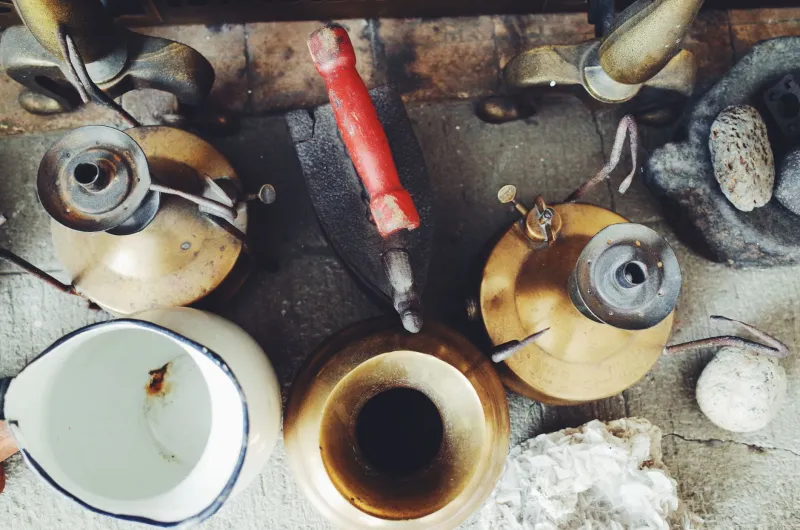
Picture western India in the years just after the 1857 uprising. In the neighborhood lanes of old Pune, a brassworker heats a flat disc of metal over charcoal, then coaxes it over an anvil into a shallow curve. His hands know the sequence without deliberation: anneal, hammer, anneal again. The vessel he is making will hold water for washing at dawn, or oil for a lamp at dusk, or flowers offered at a household shrine. Its purpose is ordinary. Its making is not.
This is the kind of object that Raja Dinkar Kelkar spent his life rescuing from obscurity. While others chased marble and gold, he understood that a brass bowl, mass-produced by the standards of its own century yet entirely handmade by ours, told the truth about how people actually lived. The museum that bears his name holds tens of thousands of such objects, and nearly all of them began exactly where this bowl did: on a workbench, in a neighborhood, in a family's daily routine.
The Itinerary of an Object
How did the bowl get from Maharashtra to the American Midwest? The routes are older than the United States itself. American merchant ships were calling at Indian ports before the Constitution was ratified; Salem, Massachusetts, built part of its fortune on India trade goods. By the nineteenth century, brass, textiles, and carved ivories moved through British colonial channels into American parlors, often as gifts between families with commercial ties.
Then comes the quieter leg of the journey: inheritance. Objects like this bowl typically change hands not through purchase but through households — a grandmother's trunk, a wedding gift carried by an emigrating relative, a box labeled 'miscellaneous' that survives three garage sales. Material culture migrates the way families do: unevenly, sometimes accidentally, always carrying more meaning than the paperwork suggests.
The woman in Columbus is, in this sense, the fourth or fifth custodian of an object that has outlived every person who first touched it. That is not exotic. That is American.
Why This Is an Immigrant-Nation Story
The United States has always been a nation of arrivals, and so has its furniture. The Shaker chair descends from English prototypes; the quilt borrows from European and African traditions; the blue-and-white china on a Kansas hutch echoes Chinese kilns. Americans are practiced at living with objects whose origins they've never investigated.
An Indian brass bowl on a nightstand is not an anomaly in this story — it is a recent verse of an old poem. The difference is distance and the assumptions we attach to it. An heirloom teapot from Yorkshire feels like lineage. An heirloom bowl from Pune feels like 'exotic décor.' Both are inherited objects; only one gets asked about its passport.
What the Object Asks of You
If you own something similar — a brass vessel, a block-printed textile, a carved wooden panel — the museum's philosophy suggests a simple practice: treat it as a biography rather than a prop.
Ask where the material came from, who would have used it, and what daily gesture it once accompanied. A water bowl implies morning routines. A lamp implies evening prayers. An object built for repetition implies a life of rhythm, something many of us are trying to recover.
And then do what families have always done: add your own chapter. Write down what you know about the piece and where you found it. The bowl in Ohio is now part of a documentation chain that runs from a Pune workshop through colonial ports and family trunks to a dresser drawer in the Midwest. That chain only stays intact if each custodian writes down their link.
A Fellow Traveler
Raja Kelkar's great insight was that the humblest objects carry the heaviest stories. A brass bowl is not a relic of a distant civilization; it is a survivor of the same forces — trade, migration, family, forgetfulness — that made America what it is. It crossed an ocean the way people do, carrying its past quietly, waiting for someone to ask.
Twelve dollars, as it turns out, was a remarkable price for two hundred years of company.