Crossing the Pacific With Their Hands: What Happens When India's Traditional Craftspeople Enter the American Classroom
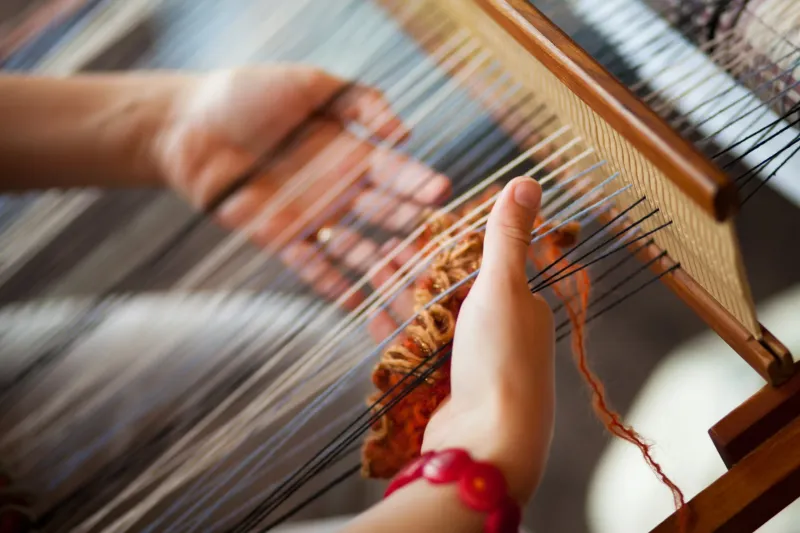
Photo: Indian master artisan teaching craft workshop demonstration hands clay weaving, via hinduinfopedia.in
For most of their working lives, India's master artisans have operated within a transmission model that is almost incomprehensible to the American academic imagination. Knowledge does not travel through syllabi or studio critiques. It passes from a senior craftsperson to a junior one through years of proximity, repetition, and a form of observation so sustained that it borders on meditation. The hand learns what the mind cannot articulate. The tradition survives because the body carries it.
Now, with increasing frequency, those same hands are arriving at American art schools, craft centers, and university residency programs—invited to teach, to demonstrate, and to share techniques that were never designed to be portable. The results are illuminating, complicated, and worth examining carefully.
A Trend With Deep Institutional Roots
The movement of Indian craft practitioners into American educational settings is not entirely new. Cultural exchange programs, Fulbright fellowships, and diaspora-driven community initiatives have long created pathways for individual artisans to spend time in the United States. What has shifted in recent years is the institutional formalization of these arrangements.
Craft schools in states including North Carolina, Vermont, and California have begun offering structured residencies specifically designed around traditional Indian techniques—block printing, Dhokra metal casting, Bidriwork, and Kantha embroidery among them. Universities with strong studio art programs have integrated Indian craft practitioners as visiting faculty, sometimes for a single semester, sometimes for longer engagements. The demand, according to program directors at several institutions, comes as much from students as from administrators.
For an American generation that has grown skeptical of mass production and increasingly drawn to the material intelligence embedded in handmade objects, the presence of a practitioner who has spent thirty years perfecting a single technique represents something that cannot be found in a textbook or a YouTube tutorial.
What the Classroom Can and Cannot Hold
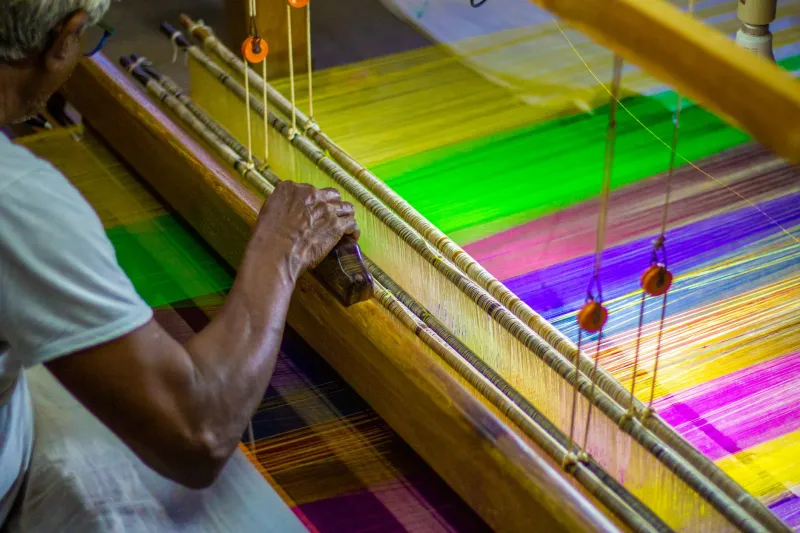
The pedagogical challenges of this exchange are significant and should not be minimized. Traditional Indian craft knowledge is, in most cases, deeply contextual. A weaver from the Banarasi tradition does not simply know how to operate a loom. She knows the specific silk suppliers, the particular dye formulations, the festival calendars that determine production cycles, the patron relationships that have shaped design vocabularies over centuries. The technique is inseparable from its ecosystem.
When that weaver enters an American classroom for a twelve-week residency, she brings her hands and her knowledge, but she cannot bring the ecosystem. Students learn the motion without the meaning—or, at best, they learn about the meaning in the way that one learns about a country from a guidebook rather than from living there.
This is not a failure of the artisan or the institution. It is an honest limitation of the format, and the most thoughtful programs acknowledge it openly. The goal, as framed by several residency directors, is not replication but encounter—giving American students a form of embodied contact with a tradition that no amount of academic study can fully substitute for.
The Documentation Imperative
One dimension of this cross-Pacific movement that has received insufficient attention is its potential contribution to craft documentation—a cause that Raja Kelkar Museum has long considered central to its institutional mission.
Raja Dinkar Kelkar spent decades documenting Indian material culture at a time when many of the objects he collected were being discarded or forgotten. His conviction that the ordinary and the handmade carried irreplaceable cultural information drove one of the most significant private collection efforts in Indian history. The documentation imperative he embodied is now being extended, in a different register, through these teaching exchanges.
Several American institutions have begun recording their residencies with unusual thoroughness—capturing not just demonstrations of technique but extended interviews with practitioners about the history, symbolism, and social context of their craft. This material, increasingly archived in accessible digital formats, represents a form of preservation that complements physical collections. The practitioner's voice, explaining why a particular motif appears in a particular context, carries information that the object alone cannot transmit.
The Authenticity Question
No examination of this trend can avoid the question that practitioners themselves raise most frequently: what happens to a technique when it is taught outside its original context, to students who will adapt it for an entirely different market?
The concern is legitimate. American craft students who learn block printing from a master of the Bagh tradition in Madhya Pradesh will, in most cases, apply what they have learned to designs, materials, and commercial contexts that have no relationship to Bagh. The technique travels; the tradition does not. The result is a new practice that carries some of the craft's material intelligence while shedding most of its cultural specificity.
Some practitioners find this outcome acceptable—even generative. Craft traditions have always evolved through contact with new contexts, and the alternative to adaptation is frequently extinction. Others are more cautious, concerned that the commercial success of American practitioners using Indian techniques without attribution or cultural acknowledgment constitutes a form of appropriation that disadvantages the communities from which the knowledge originated.
This debate does not resolve neatly, and it is not the purpose of this piece to pretend otherwise. What it does suggest is that American institutions hosting these residencies carry a responsibility that extends beyond curriculum design—a responsibility to be transparent about the origins of the knowledge being transmitted, to compensate practitioners equitably, and to actively support the communities in which these traditions remain living practices.
What This Means for the Future of Craft
The movement of Indian master artisans into American educational settings is, at its most productive, a form of living documentation—one that preserves not just technique but the human intelligence behind it. At its least productive, it risks extracting knowledge from communities that need it most and distributing it in ways that ultimately compete with those communities in the global craft market.
The difference between those two outcomes is not determined by the artisans themselves. It is determined by the institutions that host them, the students who learn from them, and the collectors who ultimately purchase the work that results. Each of those actors carries a share of responsibility for ensuring that this exchange generates something more durable than novelty—something that honors the depth of what is being shared across the Pacific, one careful hand at a time.