Tracing the Hand: A Practical Guide to Uncovering the Artisan Origins of Your Family's Indian Heirlooms
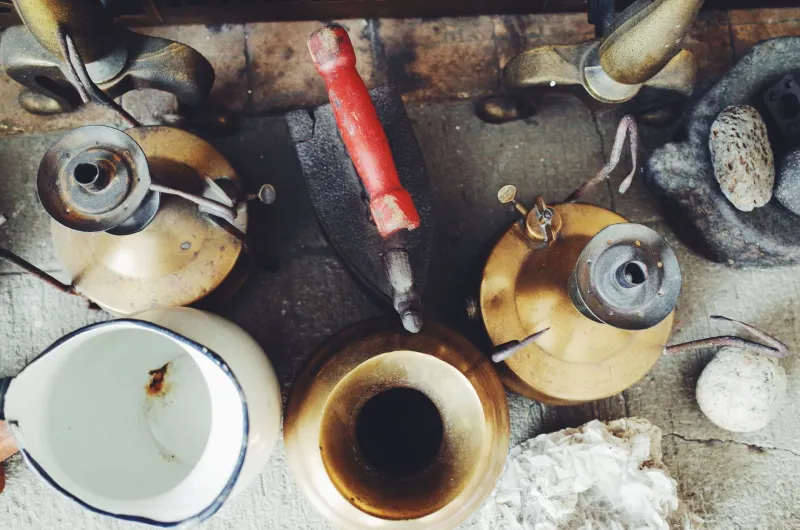
The silk textile folded in your grandmother's cedar chest. The brass oil lamp that has occupied the same corner of the living room for as long as anyone can remember. The ceramic vessel acquired decades ago on a trip to Rajasthan, its glaze a shade of blue that you have never quite seen replicated anywhere else.
For many American families, objects like these occupy a particular category of possession—cherished, displayed with care, but fundamentally mysterious. Their origins are known only in the broadest terms: India. Old. Beautiful. The name of the artisan who made them, the tradition from which they emerged, the community whose knowledge they encode—all of this has been lost, or was never recorded in the first place.
It does not have to remain lost.
The Raja Kelkar Museum, whose collection of more than 36,000 objects represents one of the most comprehensive archives of Indian material culture in existence, has long served as a research resource for scholars seeking to understand the origins and significance of Indian craft traditions. Increasingly, that expertise is being made available to families who wish to trace the genealogy of the objects they have inherited—to move from vague appreciation to genuine understanding.
This guide offers a practical framework for beginning that process.
Why Provenance Matters Beyond Price
In the art market, provenance—the documented history of an object's ownership and origin—carries primarily financial implications. An authenticated provenance increases monetary value and reduces legal risk. But for families researching inherited heirlooms, the stakes are different and, in many ways, more meaningful.
Understanding the origin of an object changes the relationship between the owner and the owned. A textile is no longer simply decorative when you know that it was produced in a weaving community in Varanasi using a technique that has been passed down through a specific family of weavers for four generations. A brass vessel is no longer simply antique when you understand that its form reflects a particular regional metalworking tradition whose practitioners are now counted in the dozens.
Raja Dinkar Kelkar understood this implicitly. His collecting was never merely acquisitive. Each object he gathered was, in his view, a record of human knowledge and creative intelligence—a document as significant as any written text, but requiring different skills to read. The mission of the Raja Kelkar Museum extends from that conviction: objects deserve to be understood, not merely admired.
Step One: Documenting What You Have
Before any research can begin, a systematic record must be created. This step is frequently underestimated by families beginning this process, but it is foundational.
For each object you wish to research, document the following:
Physical description: Dimensions, primary materials, color, surface treatment (painted, embroidered, cast, carved), and any visible inscriptions, maker's marks, or stamps. Photograph the object from multiple angles, including close-up details of any decorative elements and the underside or reverse, where marks are often found.
Family history: Write down everything you know or have been told about the object—when it entered the family, through whom, under what circumstances. Even fragmentary information ("my great-aunt brought it back from a trip in the 1950s") can serve as a useful starting point for research.
Condition notes: Document any damage, repairs, or alterations. These can themselves be evidence of age, use, and origin.
The Raja Kelkar Museum's research team recommends maintaining this documentation in both physical and digital formats, with image files stored at the highest resolution your equipment allows.
Step Two: Identifying Regional and Craft Traditions
Indian material culture is extraordinarily diverse, varying significantly by region, community, material, and period. Identifying the tradition from which an object originates is the essential second step, and it requires either developed personal knowledge or access to expert guidance.
Several categories of objects appear with particular frequency in American family collections:
Textiles: The range of Indian weaving and embroidery traditions is vast. Kantha quilts from Bengal, Banarasi silk brocades from Varanasi, Phulkari embroidery from Punjab, Ikat textiles from Odisha and Andhra Pradesh—each tradition has distinctive visual characteristics that a trained eye can identify. The weave structure, the fiber content, the dye palette, and the motif vocabulary all serve as identifying markers.
Metalwork: Brass, bronze, and silver objects from different regions of India carry distinct formal and decorative vocabularies. Dhokra lost-wax casting from Chhattisgarh looks fundamentally different from the bidriware inlay work of Karnataka or the repoussé silver of Rajasthan.
Ceramics: Blue Pottery from Jaipur, the terracotta traditions of West Bengal, and the glazed wares of various Mughal-era centers each have recognizable characteristics that can guide initial identification.
The Raja Kelkar Museum's online collection, accessible through rajakelkarmuseum.com, offers a significant visual reference base for this comparative work. For objects that resist easy identification, the museum's research inquiry service provides access to curatorial expertise.
Step Three: Consulting Specialists and Archives
Once a probable regional or craft tradition has been identified, more targeted research becomes possible. Several categories of specialist can assist at this stage.
Textile conservators with expertise in South Asian materials can analyze fiber content, dye composition, and construction techniques with a precision that visual examination alone cannot achieve. Major conservation centers associated with American art museums—the Textile Conservation Workshop in New York, for example, or the Textile Conservation Laboratory at the Cathedral of St. John the Divine—have worked with Indian textiles and can provide referrals to appropriate specialists.
Auction house specialists at major houses including Christie's, Sotheby's, and Bonhams maintain South Asian art departments whose expertise extends to decorative and domestic objects, not solely fine art. Even if you have no intention of selling, these specialists can often provide identification guidance.
Craft documentation organizations in India, including the Crafts Council of India and various state-level craft boards, maintain records of traditional craft communities and their practitioners. These organizations can sometimes assist in identifying the specific community—and occasionally the specific family—responsible for a particular type of object.
Case Study: The Iyer Family's Kantha Quilt
When Priya Iyer of Portland, Oregon, inherited a large textile from her grandmother's estate, she knew only that it had been in the family for several decades and was believed to have come from somewhere in eastern India. A preliminary inquiry to the Raja Kelkar Museum's research team confirmed that the textile was almost certainly a Kantha quilt from West Bengal—identifiable by its characteristic running stitch pattern, the recycled sari fabric from which it was constructed, and the specific motif vocabulary of its central medallion.
Further research, conducted through the Crafts Council of India and a specialist in Bengali textiles at a major American university, established that the quilt's motifs were consistent with a specific district in Murshidabad and with a period of production in the 1940s. The family now knows not only where their textile came from, but something of the community and the period it represents. The quilt has not changed. The family's relationship to it has changed entirely.
Building a Family Craft Archive
For families with multiple Indian objects, the research process itself can become a meaningful project—what might be called a craft genealogy, in which each object's story is documented and preserved alongside the family history with which it has become intertwined.
The Raja Kelkar Museum recommends creating a structured archive that includes the documentation gathered in Step One, the identification and research findings from subsequent steps, and any correspondence with specialists or institutions. This archive, passed down alongside the objects themselves, ensures that the knowledge recovered through this process is not lost again.
The objects in your home have histories that extend far beyond your family's ownership of them. They carry within their materials and their making the knowledge, the skill, and the creative intelligence of specific communities of artisans whose names, in many cases, were never recorded anywhere. To recover even a portion of that history is to restore something that was never yours to keep—and to honor the hands that made what you have inherited.