Sacred in the Ordinary: The Collecting Philosophy That Transformed How We See Indian Material Culture
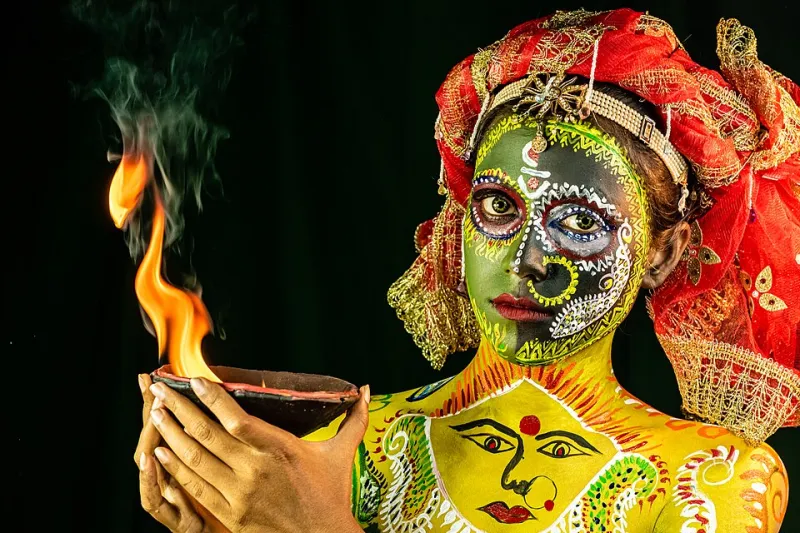
Photo: TAPAS KUMAR HALDER, CC BY-SA 4.0, via Wikimedia Commons
The Collector Who Refused to Look Away
Dinkar Kelkar was not, by training, an art historian. He was not affiliated with a university, backed by a foundation, or guided by the acquisition strategies of a curatorial board. He was a man who paid attention—to street markets, to temple courtyards, to the cluttered back rooms of artisans' workshops—and who understood, with a clarity that formal scholarship sometimes struggles to achieve, that significance is rarely announced in advance.
Over the course of several decades, Kelkar assembled a collection of more than 36,000 objects, which he eventually donated to the Indian government and which now forms the permanent holdings of the Raja Kelkar Museum in Pune. But the collection's size, while impressive, is not its most important feature. What sets it apart—what makes it a genuinely radical act of cultural preservation—is the philosophy that governed every acquisition.
Kelkar believed that the sacred and the domestic were not opposing categories. He believed that a woman grinding spices at dawn was engaged in something as spiritually significant as formal worship, and that the stone grinding wheel she used was therefore an object worthy of the same careful attention as a temple sculpture. That conviction, expressed through thousands of individual choices made over a lifetime, produced a collection unlike any other in the world.
When a Tea Cup Becomes a Text
To understand Kelkar's approach, it helps to begin with a specific example. Among the museum's holdings is a collection of tamboolas—small decorative containers used to hold betel leaf preparations, offered to guests as a gesture of hospitality and consumed as part of social and ritual occasions across much of India. To the uninitiated Western eye, these might register as charming but minor objects: small boxes, ornately decorated, pleasant to look at.
Kelkar saw something quite different. He saw in each tamboola a record of regional metalworking traditions, a document of social custom, a marker of economic status, and a reflection of the aesthetic values of the community that produced it. He saw, in other words, a text—one that could be read by anyone willing to look carefully enough.
This interpretive instinct was not unique to Kelkar, but the scale at which he applied it was extraordinary. By assembling hundreds of such objects from different regions and periods, he created the conditions under which comparison becomes possible and patterns become visible. A single tamboola tells one story. A hundred of them, arranged thoughtfully, tell the story of a civilization's relationship with hospitality, ritual, and craft.
For American collectors accustomed to evaluating objects primarily through the lens of market value or formal aesthetic quality, this approach represents a genuine alternative framework—one that asks not "Is this beautiful?" but "What does this know?"
The Spiritual Arithmetic of Everyday Life
Kelkar's philosophy was rooted in a specifically Indian understanding of the relationship between the material and the sacred—one that does not map neatly onto Western categories. In many Hindu traditions, the divine is understood to be immanent rather than transcendent: present within the world rather than standing apart from it. This means that ordinary objects, particularly those used in daily rituals, are not merely symbols of the sacred but actual loci of sacred presence.
The oil lamp lit at dusk to welcome Lakshmi into the household is not a metaphor. The grinding stone used to prepare turmeric paste for a wedding ceremony is not merely a tool. These objects participate in the spiritual life of the household in a direct and immediate way. Kelkar grasped this not as an academic proposition but as a lived reality, and his collecting practice reflected it.
The museum's extraordinary collection of dipa-lakshmi lamps—oil lamps cast in the form of the goddess Lakshmi—illustrates this beautifully. These objects were used in homes across India for centuries, their forms varying by region, their materials shifting according to the economic circumstances of their owners. But in each case, the lamp was not merely a source of light. It was a daily act of devotion made tangible, a small but genuine moment of connection between the domestic and the divine.
By preserving these objects, Kelkar was not simply saving craft traditions, though he was certainly doing that. He was insisting that the spiritual lives of ordinary Indian households deserved the same careful documentation and respectful attention as the grand gestures of kings and temple builders.
What American Collectors Can Learn
The American collecting tradition has its own deep and varied history, and it would be reductive to suggest that Western collectors are universally blind to the significance of everyday objects. The folk art movement, the growing interest in outsider art, and the sustained scholarly attention paid to material culture in American universities all represent genuine efforts to expand the frame.
But Kelkar's example offers something that these movements have sometimes struggled to articulate: a coherent philosophical framework for understanding why ordinary objects matter. It is not enough to say that a handmade quilt or a carved wooden decoy is interesting because it was made by someone outside the formal art world. The more powerful claim—the one that Kelkar's collection makes implicitly and insistently—is that these objects carry within them a record of human experience that cannot be found anywhere else.
For collectors interested in Indian material culture specifically, the implications are significant. The market for Indian art in the United States has historically focused on miniature paintings, bronzes, and textiles—categories that map comfortably onto Western notions of fine art. Kelkar's collection suggests that this focus, while understandable, is incomplete. The domestic objects, the ritual implements, the tools of everyday life: these are where the fullest picture of Indian civilization can be found.
A Legacy That Continues to Instruct
Kelkar died in 1990, but the philosophy he embodied continues to shape how the Raja Kelkar Museum approaches its mission. The collection is not a finished monument. It is a living argument—one that insists, in the face of considerable institutional pressure to the contrary, that the measure of a culture's achievement cannot be taken from its palaces and temples alone.
For visitors, scholars, and collectors willing to engage with that argument on its own terms, the rewards are considerable. The museum offers not only objects to admire but a way of seeing to practice—a discipline of attention that, once acquired, tends to change how one moves through the world. The tea cup on the kitchen shelf, the lamp on the mantelpiece, the worn wooden spoon in the kitchen drawer: Kelkar would have found significance in all of them. He was, in that sense, not merely a collector of Indian culture but a teacher of something universal.