Order Beneath the Ornament: The Mathematical Intelligence Encoded in India's Everyday Objects
When most American visitors encounter traditional Indian decorative arts for the first time, they tend to respond to the immediate sensory experience: the richness of color, the density of pattern, the apparent exuberance of form. What they rarely perceive, at least not initially, is the disciplined mathematical intelligence operating beneath that surface. The objects housed at Raja Kelkar Museum in Pune, India, present a compelling case that this oversight is not merely aesthetic but profoundly conceptual — a gap in understanding that reveals as much about Western assumptions as it does about Indian artistic tradition.
D. G. Kelkar, the collector whose life's work forms the foundation of the museum, spent decades acquiring more than 36,000 objects that document the breadth of Indian domestic and ceremonial life. What emerges from studying his collection as a whole is something that individual objects alone cannot communicate: a pattern of patterns, a recurring mathematical logic woven through centuries of craft production across radically different materials, regions, and functions.
Symmetry as a Structural Language
Consider the textile traditions represented in the museum's holdings. To the untrained eye, a woven border on a traditional sari or a block-printed cotton panel reads as decorative repetition. To someone familiar with group theory — the branch of mathematics concerned with symmetry operations — the same object reveals a sophisticated classification system. Scholars of mathematical art have identified seventeen distinct wallpaper symmetry groups, the complete set of ways a pattern can repeat across a two-dimensional plane. Remarkably, traditional Indian textile makers, working without formal mathematical notation, employed nearly all of them.
This was not accidental. The training of artisans in weaving communities was effectively a transmission of mathematical knowledge through apprenticeship. The loom itself is a computational device, translating numerical sequences into visual structure. When a weaver in a village in Rajasthan or Maharashtra set up a pattern repeat, she was encoding a mathematical instruction that the loom would execute across the full length of the cloth. The resulting fabric was simultaneously a functional household object, a work of visual art, and a physical record of mathematical reasoning.
Arithmetic Hidden in Brass and Copper
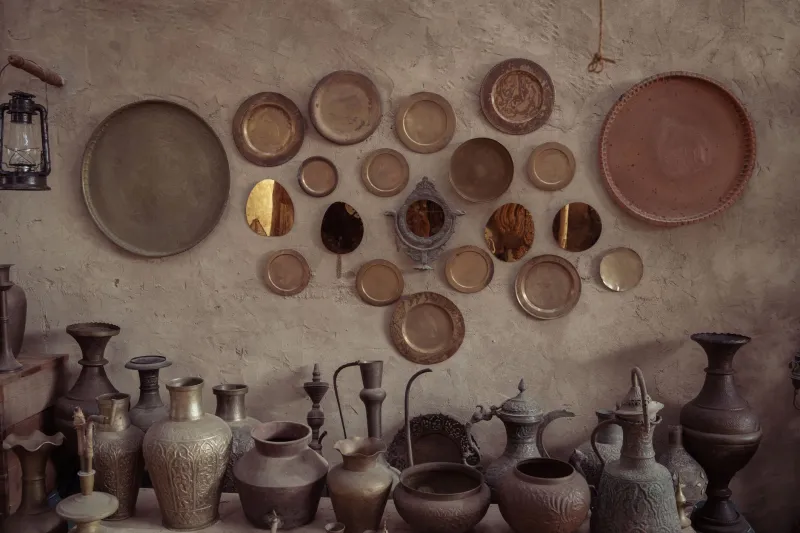
The museum's collection of metalwork offers an equally instructive case. Lamps, vessels, and ritual objects from across India's regions display a consistent preoccupation with proportional relationships that align closely with principles later formalized in Western mathematical traditions. The proportions of certain oil lamp designs, for instance, reflect ratios that recur in natural growth patterns — what Western audiences might recognize as the golden ratio or Fibonacci sequences — though Indian craftsmen arrived at these proportions through a distinct intellectual lineage rooted in texts like the Arthashastra and the Manasara, ancient treatises that treated measurement and proportion as foundational to all skilled making.
What makes the Raja Kelkar collection particularly valuable for examining these principles is its sheer comprehensiveness. Because Kelkar collected across categories — acquiring not just prestige objects but everyday utensils, tools, and domestic implements — the museum can demonstrate that mathematical proportion was not reserved for sacred or high-status objects. It was a baseline expectation embedded throughout the material culture of Indian daily life.
Kolam and the Geometry of Threshold
Perhaps no tradition in the collection illustrates this point more vividly than the objects and documentation related to kolam, the geometric floor drawings created by women at the thresholds of South Indian homes. Executed each morning using rice flour or chalk powder, kolam patterns are constructed by placing dots in a grid and then drawing continuous lines that loop around and through them. The resulting designs must satisfy strict mathematical constraints: every dot must be incorporated, lines cannot cross, and the pattern must close upon itself without leaving loose ends.
This is, in formal terms, a problem in graph theory and combinatorics. The women who create kolam are solving mathematical problems daily, often without explicit awareness that their practice maps onto academic mathematical categories. The patterns they produce include structures that mathematicians have classified as Eulerian graphs and knot diagrams — concepts that Western mathematics did not formalize until the eighteenth and nineteenth centuries.
The museum's holdings include documentation of this tradition alongside related threshold and ritual arts, situating kolam within the broader context of Indian spatial and geometric thinking. For American audiences accustomed to associating mathematical sophistication with formal education and professional practice, encountering this evidence can be genuinely disorienting — in the most productive sense.
Why the Art-Craft Distinction Fails Here
Western aesthetic philosophy has long maintained a hierarchical distinction between fine art and craft. Art, in this framework, is concerned with expression, meaning, and conceptual ambition. Craft is concerned with function, repetition, and technical skill. This distinction, which shaped the organization of Western museums from the nineteenth century onward, has had lasting consequences for how non-Western material culture is classified and valued.
The objects at Raja Kelkar Museum expose the inadequacy of this framework with particular clarity. A brass oil lamp is undeniably functional. It is also proportionally sophisticated, symbolically layered, and mathematically informed. To classify it as craft and thereby exclude it from serious aesthetic consideration is to impose a categorical structure that the object itself refuses to support.
Kelkar understood this intuitively. His collecting practice was guided by an insistence that the objects of everyday Indian life were worthy of the same careful attention given to monumental art. He was not arguing that a household lamp was equivalent to a temple sculpture. He was arguing that the distinction between them was less meaningful than Western museum culture assumed — that mathematical intelligence, aesthetic intention, and cultural meaning were present throughout the spectrum of Indian material production.
A Different Way of Seeing
For American visitors engaging with the Raja Kelkar Museum's collection, either in person in Pune or through the museum's growing digital presence, the encounter with mathematically encoded Indian objects offers an opportunity to recalibrate a set of assumptions so deeply held that they are rarely examined. The assumption that mathematical sophistication requires formal notation. The assumption that functional objects are aesthetically secondary. The assumption that non-Western artistic traditions can be appreciated emotionally without being understood intellectually.
Recognizing the geometric and mathematical structures in these objects does not diminish their beauty. It deepens it, adding a dimension of admiration for the precision of thought that produced them. A kolam that solves a graph theory problem is not less beautiful for doing so. A woven border that instantiates a wallpaper symmetry group is not less visually arresting when understood mathematically.
What changes is the nature of the encounter. It shifts from passive appreciation to active comprehension — from looking at objects to reading them. And in that shift, the distance between cultures narrows considerably. Mathematics, it turns out, is a language that crosses every border. The Raja Kelkar Museum's collection demonstrates that India's artisans have been fluent in it for a very long time.