When America Was Ready: How Shifting Values Opened the Door to Raja Kelkar's Collecting Vision
For most of the twentieth century, the dominant American relationship with objects was defined by abundance. More was better. Newer was superior. The department store, the big-box retailer, and eventually the e-commerce platform all operated on the same foundational premise: acquisition without friction, consumption without contemplation. Against that backdrop, the quiet, deeply deliberate philosophy of Dinkar Kelkar—who spent decades gathering over 36,000 objects not for spectacle but for meaning—might have seemed entirely foreign to American sensibilities.
But something has shifted. And the timing, for those who have been watching, feels less like coincidence than cultural inevitability.
The Demographic Turning Point
Millennials now represent the largest share of American consumers, and their relationship with material culture is measurably different from that of prior generations. Research consistently shows that this cohort prioritizes experience over ownership, provenance over novelty, and ethical sourcing over convenience. They are, in a word, deliberate—and that deliberateness has begun to reshape markets from furniture to fashion to fine art.
Generation Z, following closely behind, has taken these tendencies further still. The resale economy, the slow-living movement, the widespread rejection of fast fashion—these are not fringe behaviors. They represent a structural reorientation in how Americans think about the things they bring into their lives.
This is precisely the audience that Raja Kelkar Museum's philosophy was built for, even if neither party quite knew it yet.
Wellness Culture and the Object as Anchor
The American wellness industry, now valued at hundreds of billions of dollars, has spent the better part of two decades encouraging people to examine what they surround themselves with. Concepts like intentional living, mindful consumption, and the Marie Kondo-inspired practice of retaining only what brings genuine joy have become part of everyday vocabulary in ways that would have seemed eccentric a generation ago.
What is often missing from these conversations, however, is historical depth. The American wellness framework tends to be forward-looking—focused on decluttering, on starting fresh, on optimizing. What Dinkar Kelkar understood, and what his museum embodies, is that objects do not need to be minimized to be meaningful. They need to be chosen with care, understood in context, and honored for the stories they carry.
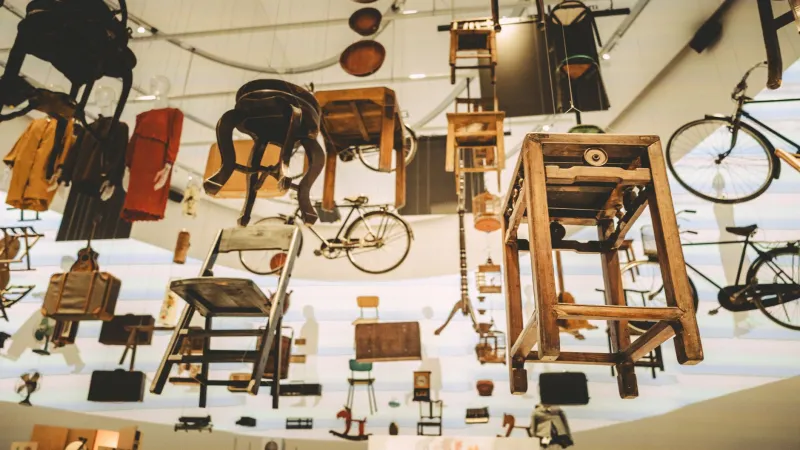
His collection includes oil lamps, betel nut cutters, palanquins, and writing instruments—objects that Western eyes might initially read as decorative curiosities. But within the framework of Raja Kelkar Museum, each item is a node in a vast network of human intention. That framing—the object as cultural document rather than mere possession—resonates powerfully with Americans who have grown tired of accumulating things that say nothing.
Sustainability and the Long View
Environmental consciousness has added another dimension to this cultural shift. The sustainability movement has forced a reckoning with the true cost of disposable goods, and that reckoning has sent many American consumers searching for alternatives. Vintage markets are flourishing. Craft fairs command serious attention. The phrase "made to last" has been rehabilitated from cliché to aspiration.
Raja Kelkar's collection, assembled across several decades of the twentieth century, is almost entirely composed of objects that were made to endure—not because durability was a marketing claim, but because the artisans who produced them understood their work as legacy. A hand-carved ivory chess set or a brass water vessel from a traditional Indian household was never intended to be discarded. It was intended to be inherited.
This long-view relationship with material culture is something American consumers are actively seeking, even if they have not always known where to find it. The museum's collection offers not just beautiful objects but a model of engagement—a demonstration that it is possible, and in fact deeply satisfying, to relate to the things in one's life as something more than temporary.
Anti-Consumerism and the Search for Authenticity
Perhaps the most striking alignment between contemporary American values and Raja Kelkar's philosophy lies in the widespread disillusionment with consumer culture itself. From the Buy Nothing movement to the growing backlash against algorithmic retail, a significant portion of the American public has begun to question the premise that more consumption equals more fulfillment.
Dinkar Kelkar never operated within a consumer framework at all. His collecting was driven by an almost scholarly devotion to Indian domestic life—to the objects that ordinary people used, revered, and passed down. He was not acquiring for status or investment. He was preserving evidence of a civilization's interior life.
That distinction matters enormously in the current American moment. Authenticity has become one of the most sought-after qualities in cultural products of all kinds, and it is notoriously difficult to manufacture. What Raja Kelkar Museum offers is authenticity in its most unimpeachable form: a collection assembled by a man who cared, about objects made by people who cared, representing a culture that understood care as a civic and spiritual obligation.
The Role of Diaspora and Cross-Cultural Curiosity
The United States is also home to one of the world's largest Indian diaspora communities, concentrated in cities like New York, Chicago, Houston, San Jose, and Atlanta. For many members of this community, the Raja Kelkar Museum represents something profoundly personal—a connection to a heritage that rapid modernization and geographic distance can erode. But the museum's reach extends well beyond diaspora audiences.
American interest in South Asian art and culture has grown substantially in recent years, driven in part by the mainstreaming of yoga and Ayurveda, the global success of Indian cinema, and a broader appetite for non-Western aesthetic traditions. This curiosity creates a receptive environment for a deeper engagement with Indian material culture—one that moves beyond surface-level exoticism toward genuine understanding.
A Philosophy Whose Moment Has Arrived
Raja Kelkar Museum has always been, at its core, an argument about value—about what deserves to be saved, studied, and celebrated. For much of its existence, that argument was made primarily to Indian audiences navigating the tensions between tradition and modernity.
But the argument translates. The American consumer who has grown weary of buying things that mean nothing, who is searching for objects with genuine stories, who wants to understand the world through its material culture rather than merely decorate a shelf—that person is ready for what this museum has always offered.
The geography of taste has shifted. And Dinkar Kelkar's vision, patient and principled across the decades, finds itself standing at the center of a conversation it was always meant to join.