The Handmade Object as Cultural Counterpoint: Why Indian Craft Has Become America's Quiet Protest
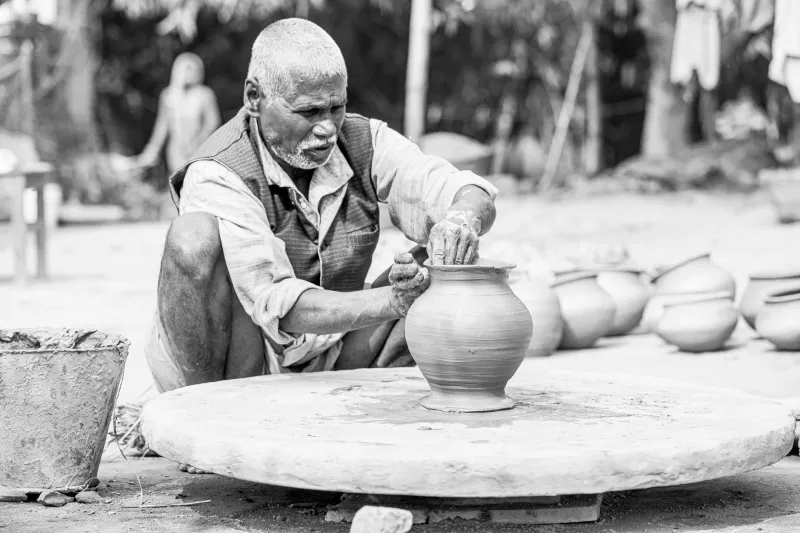
There is something quietly subversive about choosing to own an object that a human being made with their hands.
This observation would have seemed unremarkable for most of human history, when handmade objects were simply the only kind available. But in the contemporary American consumer landscape—where nearly every purchasable good is the output of an automated supply chain, where the distance between desire and delivery has been compressed to forty-eight hours, and where objects are designed with planned obsolescence as a feature rather than a flaw—the deliberate choice of the handmade constitutes a statement. It is, in its quiet way, a refusal.
Among affluent American millennials and Gen-Z collectors, Indian domestic arts and handicrafts have become particularly potent vehicles for this refusal. The reasons are worth examining carefully, because they illuminate something important not only about changing American tastes but about the enduring relevance of a collecting philosophy that D.G. Kelkar practiced in Pune decades before the word sustainability entered mainstream vocabulary.
The Exhaustion of Abundance
To understand why Indian handmade objects have acquired symbolic weight in American collecting culture, it is necessary to understand the context from which that symbolism emerges.
The postwar American consumer economy was built on a specific promise: that abundance itself was a form of freedom. The capacity to acquire—quickly, cheaply, and in volume—was positioned as both a personal right and a national achievement. For generations, this promise delivered on its terms. Homes filled with goods; wardrobes expanded; the marketplace responded to every expressed desire with a product designed to satisfy it.
The consequences of this arrangement are now widely understood. Environmental costs that were externalized for decades have become impossible to ignore. The psychological effects of living in environments saturated with undifferentiated objects—objects that carry no story, no human connection, no particular claim on attention—have been documented extensively. And the cultural homogenization that results from global supply chains producing identical goods for identical markets has left many consumers with a specific kind of hunger: a hunger for the particular, the traceable, the irreducibly human.
Into this hunger, Indian handicrafts arrive with considerable force.
What These Objects Actually Carry
The appeal of Indian domestic arts is not primarily aesthetic, though the aesthetics are frequently extraordinary. It is ontological. These objects exist in a fundamentally different relationship to their own making than the products that fill American retail environments.
Consider what is embedded in a single piece of hand-block-printed cotton from Jaipur. The wooden printing blocks were carved by a specialist whose family has practiced the trade for generations. The natural dyes were prepared according to formulas that predate industrial chemistry. The printer's hand applied each block with a pressure and rhythm developed through years of practice. The cloth itself was woven on a loom operated by a human being making constant micro-adjustments in response to the specific qualities of the thread. At every stage, a person made a decision. At every stage, a human intelligence engaged with a physical material.
No algorithm was involved. No optimization function was applied. The object that results from this process carries, within its physical structure, the evidence of all these human engagements. It is, in the most literal sense, a record of human attention.
For a generation that has grown up surrounded by objects that carry no such record—that arrived in the world through processes deliberately designed to eliminate human variability—this quality is not merely appealing. It is revelatory.
Raja Kelkar's Values System, Rediscovered
D.G. Kelkar did not describe himself as a cultural revolutionary. He was a man of deep aesthetic conviction who believed that the ordinary objects of Indian domestic life deserved the same serious attention that was routinely extended to temple sculpture and court painting. His collection—assembled over a lifetime and now housed in the museum that bears his name in Pune—reflects a values system that prioritized depth over novelty, human intelligence over mechanical production, and cultural continuity over fashionable acquisition.
What is striking, from the vantage point of the present, is how precisely this values system maps onto the concerns driving the most thoughtful contemporary American collectors.
The sustainability dimension is perhaps the most obvious point of convergence. Objects made from natural materials by skilled artisans using traditional methods have inherently low environmental footprints. They are not produced in factories running on coal-fired electricity. They are not shipped in containers stacked with identical units. They are not designed to be discarded after two seasons. They are, by their nature, the opposite of disposable—and in a culture increasingly conscious of the environmental cost of disposability, this quality carries genuine moral weight.
But the sustainability argument, while real, understates the depth of what is actually happening. The American collectors who are most seriously engaged with Indian handicrafts are not simply making environmentally responsible purchasing decisions. They are articulating a position about what kinds of human relationships they wish to participate in and what kinds of objects they wish to surround themselves with. The handmade object is a node in a network of human connection—between maker and material, between tradition and practitioner, between object and owner—that mass production systematically destroys.
Luxury Redefined
The shift underway in American collecting culture represents, among other things, a fundamental renegotiation of what luxury means.
For most of the twentieth century, luxury in America was defined by exclusivity of access—by the capacity to acquire what others could not. This logic produced a consumer landscape in which status was performed through brand recognition and price point, and in which the most desirable objects were those most effectively marketed rather than most skillfully made.
The collectors reshaping this landscape are operating on different premises. For them, the luxury lies not in exclusivity of access but in depth of knowledge—in understanding what an object is, where it comes from, who made it, and why it matters. An Indian dhokra bronze acquired with full knowledge of the lost-wax casting tradition it represents, purchased directly from an artisan cooperative in Jharkhand, carries a status that no logo can confer. It is the status of the person who knows the difference between a thing and its story.
This is, again, a sensibility that would have been entirely familiar to D.G. Kelkar. His collection was not assembled to signal wealth. It was assembled to demonstrate understanding—to make visible, through the intelligent arrangement of carefully chosen objects, a comprehensive knowledge of India's material culture and the human intelligence embedded within it.
The Museum as Mirror
The Raja Kelkar Museum is, among many other things, a record of one man's values. Every object in its collection reflects a choice—a judgment that this particular thing, made by these particular hands, in this particular tradition, deserved to be preserved and understood rather than discarded or forgotten.
American collectors who are drawn to Indian handicrafts are, whether they know it or not, engaging with the same set of values. They are choosing objects that require attention, reward knowledge, and resist the logic of disposability. They are participating, in their own way, in the project of preservation that animates the museum's mission.
That this should be happening at a moment when the contradictions of consumer culture have become impossible to ignore is not, perhaps, a coincidence. The handmade object has always carried within it a counter-narrative to the logic of mass production. It has simply taken American culture some time to become fluent in the language it speaks.