Fewer, Better: The Radical Collecting Wisdom That Built One of India's Greatest Museums
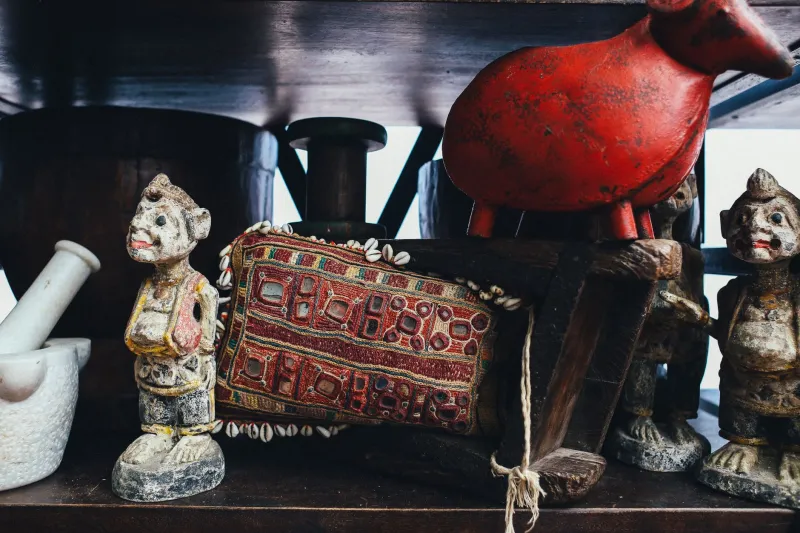
There is a quiet irony at the heart of the Raja Kelkar Museum in Pune, India. The institution houses more than 36,000 objects — nutcrackers, lamp stands, betel boxes, ivory combs, ceremonial vessels, and painted panels — and yet the experience of moving through its galleries does not feel like confronting a hoard. It feels like reading a carefully composed argument. Every object earns its place. Every display answers a question. The collection, vast as it is, carries the unmistakable signature of a man who understood that accumulation without intention is merely clutter wearing a respectable disguise.
For American collectors navigating an age of abundance — thrift store hauls, estate sale discoveries, eBay rabbit holes, and algorithmically curated online marketplaces — that distinction is worth examining at length.
The Difference Between a Collection and an Accumulation
Dr. Dinkar Kelkar, the collector whose lifelong passion gave rise to the museum, did not simply gather objects he found beautiful or unusual. He pursued artifacts that illuminated the texture of Indian domestic life across centuries — objects that carried cultural memory, revealed craft traditions, and spoke to one another across time and region. A brass oil lamp did not stand alone; it entered into conversation with the ceremonial vessels beside it, the decorative motifs above it, and the historical moment from which it emerged.
This is the foundational distinction that separates a collection from an accumulation: coherence. A collection possesses an internal logic that makes the whole greater than the sum of its parts. An accumulation is simply the sum of its parts — and often less, because the parts compete for attention rather than amplifying one another.
American collectors, particularly those drawn to antiques, folk art, or global crafts, frequently begin their journeys with genuine curiosity and end them with overcrowded shelves. The objects that once sparked delight begin to blur into background noise. The newest acquisition displaces the previous one before its story has been fully understood. What was meant to be a meaningful practice quietly becomes a consuming habit.
Why Restraint Is the Collector's Most Underrated Skill
The counterintuitive truth that Kelkar's museum demonstrates is this: the fewer objects you acquire with clear intention, the more powerfully each one speaks. When a collection is curated with discipline, every addition carries weight. The collector is forced to ask not merely do I want this? but does this belong here? — a question that demands a working understanding of what here actually means.
That second question is transformative. It requires the collector to have developed a point of view — a thesis, almost — about what they are building and why. Without that thesis, a collection is simply a record of passing enthusiasms. With it, even a modest grouping of twenty objects can convey something genuinely profound about a culture, a period, or a way of life.
In contemporary American collecting culture, this discipline is increasingly rare. Digital platforms have made acquisition frictionless. Storage has become cheap. The psychological reward of the find arrives faster than the slower satisfaction of deep understanding. The result, for many collectors, is a kind of object inflation: the more they acquire, the less each individual piece means.
What 36,000 Objects Actually Teach About Selectivity
It would be easy to misread the Raja Kelkar Museum's scale as a contradiction of the principle being argued here. Thirty-six thousand objects is not a small number. But context matters enormously. Kelkar spent decades assembling this collection, beginning in the 1920s and continuing until the museum's formal establishment in 1962. Each category within the collection — the door frames, the palanquins, the writing instruments, the toys — represents sustained, focused inquiry into a particular dimension of Indian material culture.
The collection is large because Kelkar's inquiry was deep, not because his acquisitions were casual. He did not buy everything that crossed his path; he pursued specific things with specific purposes. The 36,000 objects represent the output of a lifetime of disciplined curiosity, not the residue of undirected appetite.
This distinction matters for American collectors who sometimes confuse a museum's scale with a license for their own indiscriminate purchasing. The lesson Kelkar offers is not collect as much as you can. It is know what you are collecting and why, then collect that thing with rigor and patience.
Applying the Kelkar Principle to American Spaces
For collectors working with American homes — whether a Brooklyn apartment, a Santa Fe adobe, or a craftsman bungalow in Portland — the practical application of this philosophy begins with a simple exercise: articulate, in one or two sentences, what your collection is actually about. Not what it contains, but what it means. What question is it answering? What story is it telling?
If that sentence cannot be written, the collection likely lacks the coherence that transforms objects into arguments. The remedy is not necessarily to acquire more; it is often to release what does not belong and to look more carefully at what remains.
Museum curators refer to this process as deaccessioning — the formal removal of objects that no longer serve the institution's mission. Private collectors rarely think in these terms, but the principle is equally valid in a domestic context. A collection refined by thoughtful subtraction frequently becomes more powerful than one expanded by unexamined addition.
The Emotional Economy of Owning With Intention
There is also a psychological dimension to this argument that deserves acknowledgment. Collectors who acquire with intention tend to develop richer relationships with individual objects. They know the provenance, understand the craft tradition, can explain the cultural context. Each piece holds a story that the collector can tell — to guests, to family, to themselves. That narrative investment transforms ownership into stewardship.
By contrast, collectors who accumulate without intention often find that their objects become emotionally inert over time. The thrill of acquisition fades, and what remains is simply stuff — stuff that demands dusting, storage, and eventually the difficult reckoning of an estate sale or a donation drive.
Kelkar understood that objects carry their meaning forward only when someone accepts the responsibility of understanding and transmitting it. His museum exists precisely because he took that responsibility seriously — not just for the grandest artifacts in his collection, but for the nutcracker, the betel box, the humble oil lamp that illuminated an ordinary Indian evening centuries ago.
A Different Kind of Abundance
The Raja Kelkar Museum does not argue against collecting. It argues, quietly and persuasively, for collecting differently. Its galleries suggest that the most meaningful collections are not the largest ones but the most intentional ones — the ones where every object has been chosen because it belongs, where the whole tells a story no single piece could tell alone.
For American collectors willing to embrace that discipline, the reward is a different kind of abundance: not the abundance of things, but the abundance of meaning. Fewer objects, understood deeply, can fill a home — and a life — far more completely than thousands understood not at all.