When Knowledge Becomes a Burden: The Ethical Weight of Researching Your Indian Collection
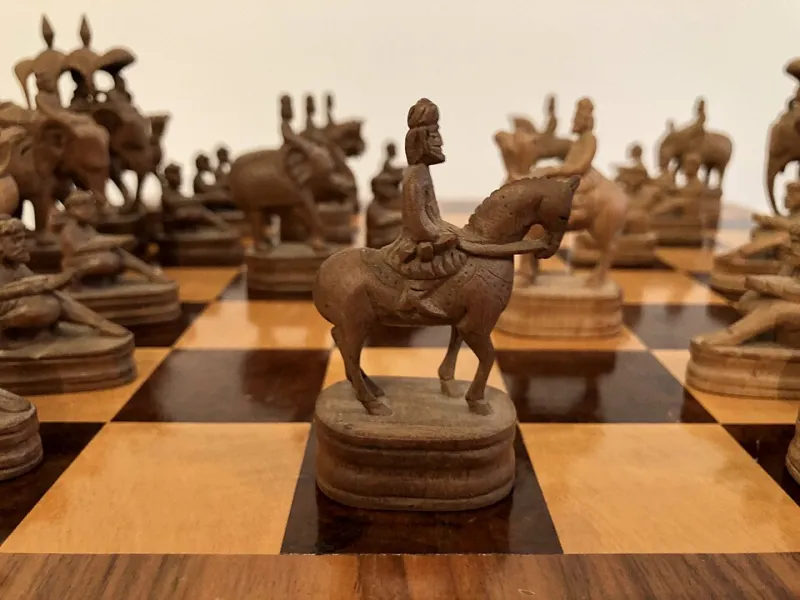
Photo: Chaturaji, CC BY-SA 4.0, via Wikimedia Commons
There is a particular kind of silence that falls over a collector when research delivers an answer they were not entirely prepared to receive. It is not the silence of ignorance. It is the silence of someone who has just learned something that changes the nature of their relationship to an object they love, and who is not yet certain what to do with that knowledge.
This experience is becoming more common among American collectors of Indian art and material culture. As digital archives expand, as diaspora communities make regional histories more accessible to Western researchers, and as the ethics of collecting receive sustained public attention, the distance between a beautiful object and its complicated origin is collapsing. What was once obscured by geography and time is now frequently a few hours of careful online research away.
The question that follows is not simple: what does a collector owe the truth once they have found it?
The Information Landscape Has Changed
A generation ago, an American collector who acquired a piece of traditional Indian craft—a carved wooden panel, a silk textile, a bronze ritual object—could reasonably claim that its history was opaque. Provenance research required access to specialized archives, knowledge of regional languages, and professional contacts that most private collectors did not possess. Ignorance, if not entirely innocent, was at least structurally enforced.
That structure has largely dissolved. Online databases maintained by institutions including the Victoria and Albert Museum, the Smithsonian, and various Indian state archives have made substantial amounts of historical documentation publicly accessible. Academic researchers whose work was once confined to specialist journals now publish in formats designed for general audiences. Craft communities themselves—through social media, advocacy organizations, and diaspora networks—have become increasingly effective at telling their own histories and, in some cases, tracing the dispersal of objects that originated in their regions.
The result is that the American collector who wishes to know the history of what they own can, in many cases, find it. The collector who prefers not to know must now make that preference active rather than passive. Ignorance has become a choice.
What Research Reveals
The discoveries that await collectors who pursue serious provenance research vary considerably in their moral complexity. Some are simply illuminating—learning that a textile came from a particular village in Rajasthan, that its pattern reflects a specific festival tradition, that it was likely made by a weaver belonging to a particular caste community whose craft identity has been documented by regional historians. This kind of knowledge enriches ownership without destabilizing it.
Other discoveries are more difficult. Colonial-era acquisition records reveal that many Indian objects entered Western collections through processes that ranged from economically coercive to straightforwardly illegal. Objects removed from temples, domestic items acquired during periods of famine when their owners had no genuine choice about selling, craft products purchased through intermediary systems that captured almost none of the value for the artisans who made them—these histories are not rare, and they are not confined to museum collections. They exist in private homes across the United States.
Still other discoveries involve communities rather than transactions. A collector who traces a particular embroidery tradition may find that the community responsible for it was displaced by partition, by development projects, or by the collapse of patronage systems that once sustained it. The object in their possession may be among the last surviving examples of a practice that no longer has living practitioners. That knowledge transforms the object's meaning entirely—and transforms the collector's relationship to it.
The Transformation of Ownership
Raja Dinkar Kelkar, whose extraordinary collection forms the foundation of the museum bearing his name in Pune, understood something that many Western collectors have been slower to absorb: ownership of a culturally significant object is not a terminus. It is a form of stewardship with obligations attached.
Kelkar did not acquire objects to possess them in any simple sense. He acquired them to preserve them, to document them, to make them available for interpretation, and ultimately to return them—through the gift of his collection to the public trust—to a form of communal ownership. His collecting philosophy was animated by the conviction that the object's meaning belonged to the culture that produced it, and that the collector's role was custodial rather than proprietary.
This framework is available to American collectors, though it requires a significant reconceptualization of what ownership means. An object whose history has been fully researched—whose origins, labor conditions, and cultural context are understood—is no longer simply a possession. It is a responsibility. It carries claims that extend beyond the collector's legal title to it.
What Ethical Collecting Actually Demands
The demands of ethical collecting, once knowledge has been acquired, are not uniform. They depend on what the research reveals, and they exist on a spectrum that ranges from modest to genuinely consequential.
At the modest end: collectors who learn the regional and cultural origins of their objects can acknowledge those origins publicly—in the way they describe their collections to guests, in the labels they create for displayed objects, in the stories they tell their children about what they own. This acknowledgment costs nothing and generates a form of cultural respect that compounds over time.
More substantively: collectors who discover that their objects originated in communities that still exist—and that still practice, or are attempting to revive, the craft traditions from which those objects came—can direct financial support toward those communities. Purchasing directly from contemporary artisans in the same tradition, supporting preservation organizations working in the relevant region, or contributing to documentation efforts like those championed by institutions such as Raja Kelkar Museum are all forms of active stewardship that respond to knowledge with action.
At the most consequential end: collectors who discover that their objects were acquired through genuinely coercive or illegal means face harder questions about whether continued possession is defensible. These situations are less common than critics of Western collecting sometimes suggest, but they are not hypothetical. When they arise, the ethical path is rarely obvious, and it almost always requires conversation with the communities most affected rather than unilateral decision-making by the collector.
The Discomfort Is the Point
There is a temptation, when research yields uncomfortable results, to conclude that ignorance was preferable—that knowing less would have allowed for a simpler and more enjoyable relationship with a beautiful object. This temptation should be resisted.
The discomfort that knowledge generates is not a problem to be managed. It is information. It is the felt experience of a moral relationship becoming visible, of the human labor and cultural meaning embedded in an object asserting itself against the collector's desire for uncomplicated pleasure. That assertion is legitimate, and the discomfort it produces is a form of respect being demanded by the object itself.
The American collector who allows that discomfort to prompt inquiry, action, and a more honest relationship with their collection is not a worse collector for having learned the truth. They are a more serious one—and that seriousness is, ultimately, what the objects they own have always deserved.