Light That Remembers: How Indian Oil Lamps Reframe the American Mood-Lighting Habit
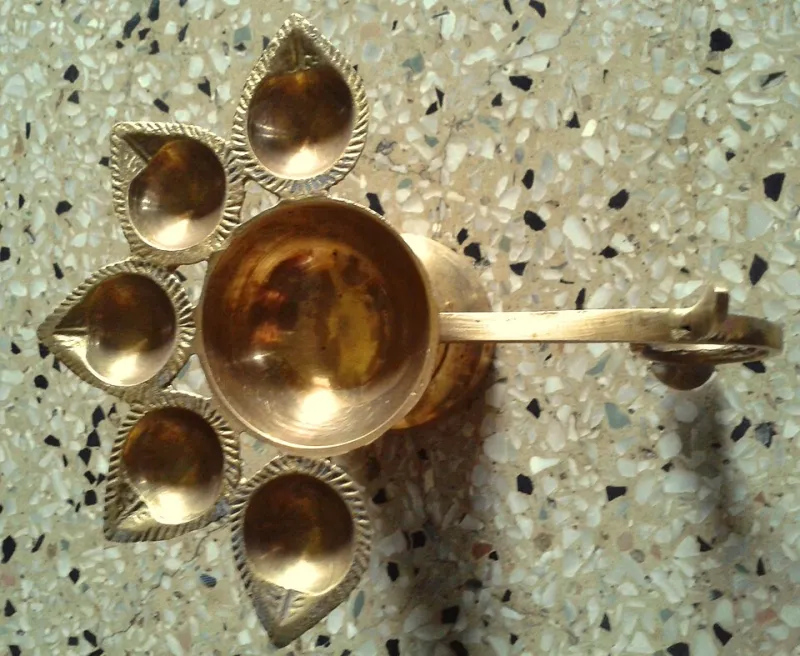
Photo: Amitbsws, CC BY-SA 4.0, via Wikimedia Commons
In American homes, light has become a setting. A smart bulb can be dimmed from a phone; a floor lamp can be aimed at a wall; a candle can be switched on with a battery. The language of contemporary interiors treats illumination as atmosphere, and atmosphere as something to be tuned like a playlist. That habit is not wrong, but it is incomplete. At the Raja Kelkar Museum in Pune, India, lamps are not primarily settings. They are witnesses. The museum's collection of Indian lighting objects—oil lamps among them—invites a different question: not what a room should look like, but what a lamp has already seen.
The Difference Between Atmosphere and Testimony
An American mood-lighting setup usually begins with a desired effect. The room should feel warm, calm, dramatic, or restrained. The lamp is selected to produce that effect, and the bulb is chosen to refine it. An Indian oil lamp often begins with a task: to hold oil, carry a wick, protect a flame, and place light where a household needed it. The object's beauty may be real, but it is inseparable from use. A hanging lamp may have marked a doorway; a small portable lamp may have traveled; a shrine lamp may have belonged to a daily ritual. Even when we cannot recover a particular lamp's full history, the form itself records a relationship between light and obligation.
What a Lamp Carries
Many of the lamps in the Raja Kelkar collection are humble in material and ambitious in meaning. Brass, clay, bronze, and mixed metals appear in forms that range from simple saucers to elaborate hanging fixtures. A wick channel, an oil reservoir, a handle, and a hanging loop are not decoration alone; they are instructions for use. A handle implies movement. A loop implies suspension. A shallow bowl implies a wick that needs tending. The museum preserves these objects not to freeze them but to keep their instructions legible. The lamp is a tool, a vessel, and a record in one.
The American Mood-Lighting Reflex
American retail has trained shoppers to buy light by temperature: warm white, soft white, daylight. Home-improvement television and social media have trained them to layer light by height and texture. The result is often beautiful, but it can also be forgettable. A room lit by a dimmable LED may feel calm, yet the light itself has no story. It can be changed, replaced, or forgotten. This is where the museum's lamps offer a correction. They do not ask Americans to reject modern lighting. They ask for a hierarchy: memory first, atmosphere second.
A Practical Exercise: Reading Light Before Replacing It
For readers in the United States who want to test this idea, begin with one room and one lamp. Before buying a new fixture, identify the oldest light-bearing object in the house. It may be a grandmother's bedside lamp, a brass candleholder, a souvenir from a trip, or a simple night light that has outlasted three moves. Write down three facts: where it came from, what it was used for, and who tended it. If the answers are unknown, note that too. Then decide whether the object should remain in storage, move to a visible shelf, or be retired. The point is not to turn a home into a museum display. It is to let one light source carry a story that a smart bulb cannot.
Lighting a Room With Memory
A museum can seem like a place of preservation, but its deeper work is instruction. The Raja Kelkar Museum's lamps teach Americans that light is not only a product to be adjusted. It is a record of labor, travel, ritual, and household rhythm. The next time a room feels unfinished, the answer may not be another dimmable bulb. It may be a single lamp—old or new—chosen because it has something to say, and placed where its story can be seen.